TASTY HANGUL · KOREAN FOOD #16
Read the menu · Pick your galbi · Order in Korean · Eat like a local
Hey, Sikgu!
Wondering what “Sikgu” means? Find out here →
Galbi!!! You know Korean galbi, right? One of the first things that pops into your head when you hear Korean BBQ!
But hang on! You walk into a galbi restaurant, open the menu… and spot strange little words in front of “galbi.”
Different names? Different flavors? What exactly are you ordering? And wait—is grilling the only way to eat galbi?
All right, Sikgu! Let’s crack the galbi menu code, one clue at a time.
01 Galbi? Let’s Read It First!
Galbi (갈비) means ribs—the ribs and the meat around them. But wait… what kind of ribs are we talking about?
Quick note: galbi isn’t the same as bulgogi. Bulgogi is thinly sliced, marinated meat. Galbi is all about the rib cut, often served with the bone still attached.
LET’S READ HANGUL
갈비
galbi · ribs
갈
ㄱ + ㅏ + ㄹ
g + a + l → gal
비
ㅂ + ㅣ
b + i → bi
The final ㄹ in 갈 sits at the bottom of the syllable. That’s a batchim (final consonant). 갈 (gal) + 비 (bi) = 갈비 (galbi)!
So… are we ordering beef galbi or pork galbi?
Both are possible! Here’s where Hangul comes in. The Korean words for the animal and its meat are a little different, just like cow / beef and pig / pork in English. Take a look:
| Cow → Beef galbi | Pig → Pork galbi | |
|---|---|---|
| Animal | 소 (so) Cow / Cattle | 돼지 (dwaeji) Pig |
| Meat | 소고기 (sogogi) Beef | 돼지고기 (dwaejigogi) Pork |
| On the menu | 소갈비 (sogalbi) Beef galbi | 돼지갈비 (dwaejigalbi) Pork galbi |
See the pattern? 소 → 소고기 → 소갈비. 돼지 → 돼지고기 → 돼지갈비. Korean menu names often tell you the main ingredient. Once you spot these words, you’re already reading the menu!

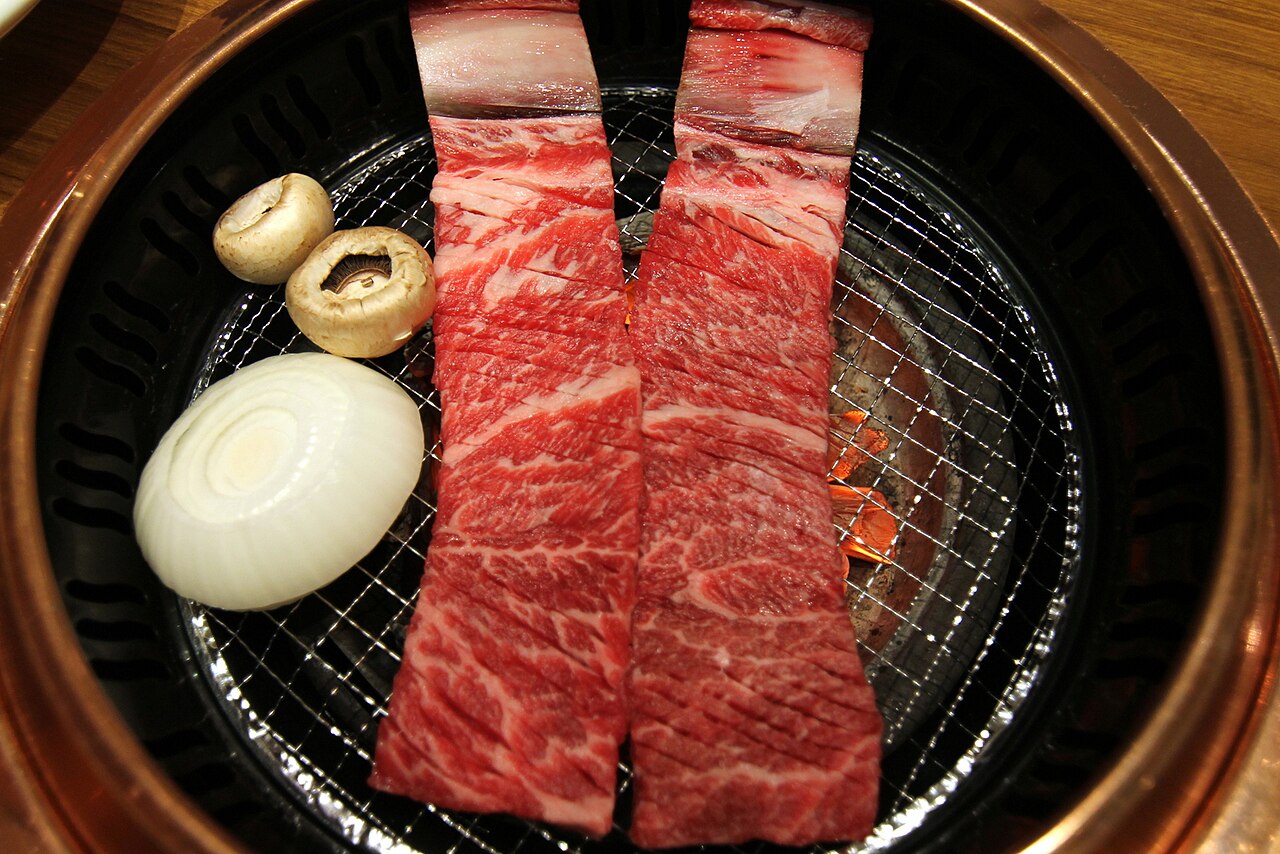
Photo: National Institute of Korean Language · Original · CC BY-SA 2.0 KR
One little heads-up: Some menus simply say “갈비 (galbi)” without specifying beef or pork. And not every restaurant serves both. When in doubt, ask before ordering!
02 Saenggalbi? Yangnyeom Galbi? Two New Animals?!
Saenggalbi (생갈비)? Wait… is “saeng” an animal?
Yangnyeom galbi (양념갈비)? Don’t tell me “yangnyeom” is another one!
Nope, nope! No new animals here. Haha!
This time, the clue isn’t which animal. It’s how the meat is prepared.
생갈비
saenggalbi
Unmarinated galbi
No marinade. You get to taste the meat itself. And no, “saeng” doesn’t mean you eat it raw!
양념갈비
yangnyeom galbi
Marinated galbi
Galbi coated in a savory-sweet marinade, often made with soy sauce.
Which one sounds like your kind of galbi? Want to taste the meat itself? Go for saenggalbi. Craving something sweet and savory? Try yangnyeom galbi.
My pick if you want both: start with unmarinated galbi, then move on to the marinated kind. Let the milder flavor have its moment first!
Two Keys to Reading a Galbi Menu
STEP 1 · Which animal?
소 vs 돼지
so vs dwaeji
Beef vs Pork
STEP 2 · Marinated?
생 vs 양념
saeng vs yangnyeom
Unmarinated vs Marinated
Put these two clues together, and the menu gets a lot easier to decode. Just remember: not every restaurant offers all four combinations.
One more thing: Depending on the restaurant, pork galbi may include cuts other than the rib area.
03 All Right. Let’s Order!
You’ve picked your galbi. Now let’s order it in Korean! Meat at Korean BBQ restaurants is commonly ordered by the number of 인분 (inbun · servings).
돼지갈비 2인분 주세요.
Dwaejigalbi i-inbun juseyo.
Two servings of pork galbi, please.
생갈비 3인분 주세요.
Saenggalbi sam-inbun juseyo.
Three servings of unmarinated galbi, please.
양념갈비 2인분 주세요.
Yangnyeom galbi i-inbun juseyo.
Two servings of marinated galbi, please.
Still not sure if it’s beef or pork? Here’s one more useful question:
이 갈비는 소고기예요, 돼지고기예요?
I galbineun sogogiyeyo, dwaejigogiyeyo?
Is this galbi beef or pork?
The easiest way to order is to say the name you see on the menu. If it only says saenggalbi or yangnyeom galbi, ask which meat it is first.
04 Now, Let’s Eat Galbi the Korean Way!
Galbi is delicious straight off the grill. But why stop there? Here are a few ways I like to enjoy it!

Photo: donchili · Original · CC BY-SA 2.0
쌈 ssam · lettuce or leafy wrap
Put a piece of galbi on a lettuce or perilla leaf, wrap it up, and take a bite. That little bundle is part of the fun of Korean BBQ! (New to it? Here’s how Korean BBQ works.)
밥 bap · rice
Sweet-and-savory marinated galbi and a bowl of warm rice? Perfect together. One bite of meat, one spoonful of rice!
냉면 naengmyeon · cold noodles
And now for a combination I really want you to try: hot galbi + ice-cold naengmyeon! Pick 물냉면 (mul-naengmyeon · cold noodle soup) or 비빔냉면 (bibim-naengmyeon · spicy mixed cold noodles)—either works.
Wrap some noodles around a bite of marinated galbi and… BOOM! A flavor explosion! Yes, the noodles are supposed to be cold. No need to panic. Haha!
소주 soju · Korean spirit
If you enjoy a drink, a little soju with galbi is a great pairing in my book!
Some galbi restaurants serve fried rice (볶음밥, bokkeumbap), others don’t. Check the menu for the sides available at your table.
05 Oh! Galbi Isn’t Just for Grilling!
Remember that question from the beginning? Is galbi always cooked on a grill?
Not at all! Galbi has a few other delicious sides to its personality.
- 갈비찜 (galbijjim · braised short ribs) — Ribs slowly cooked in a seasoned sauce until tender. A dish you’ll also find at holidays and special gatherings.
- 갈비탕 (galbitang · beef short rib soup) — Beef ribs simmered into a comforting soup. It was once a familiar dish at Korean wedding receptions, too.

Photo: Beeniru · Original · CC BY-SA 3.0
If you fall for grilled galbi, don’t leave Korea without trying galbijjim or galbitang sometime. Same word, very different experience!
You’re a Galbi Master Now, Sikgu!